
- info@rahulkulkarni.in
- 1307/1308, Centrum Business Square, Road No 16, Wagale Estate, Thane (W)
Mutual Fund Risk
01
Guide
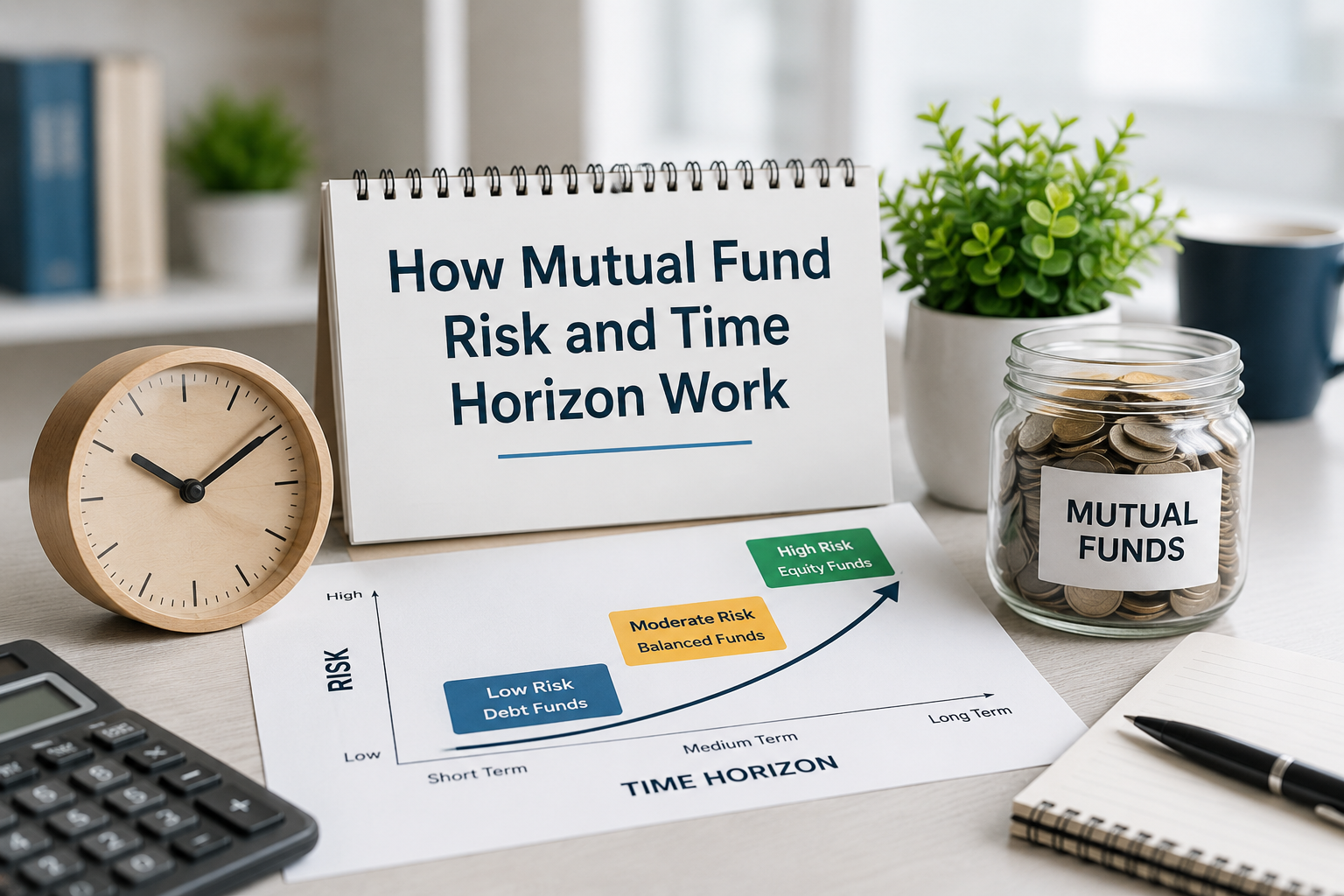
How Mutual Fund Risk and Time Horizon Work
Investing in mutual funds is one of the most effective ways to build long-term wealth, but every investment comes with a certain level of risk. Understanding how risk and investment time horizon work together is essential for making informed financial decisions. Many investors focus only on expected returns, while overlooking how their investment duration and risk tolerance can significantly influence outcomes.
Whether you are investing for a short-term goal, planning your child's education, purchasing a home, or building a retirement corpus, choosing the right mutual fund depends on both your willingness to take risk and the amount of time you can stay invested.
What is Mutual Fund Risk?
Mutual fund risk refers to the possibility that your investment value may fluctuate due to changes in market conditions. Unlike fixed deposits, mutual funds invest in financial assets such as stocks, bonds, government securities, and money market instruments whose values can rise or fall over time.
Different mutual funds carry different levels of risk depending on the assets they invest in.
Common types include:
- Market Risk
- Interest Rate Risk
- Credit Risk
- Liquidity Risk
- Inflation Risk
- Currency Risk (for international funds)
Although risk cannot be completely eliminated, it can be managed through diversification, professional fund management, and proper asset allocation.
Understanding Investment Time Horizon
Your investment time horizon is simply the period you plan to keep your money invested before you need it. Generally, investment horizons can be divided into three categories:
Short-Term (Less than 3 Years)
Short-term investors generally seek capital preservation and liquidity. Since markets can fluctuate significantly over a short period, lower-risk investment options are usually preferred.
Suitable mutual funds include:
- Liquid Funds
- Ultra Short Duration Funds
- Low Duration Debt Funds
- Money Market Funds
These funds aim to provide relatively stable returns with lower volatility.
Medium-Term (3–5 Years)
Investors with medium-term goals can consider a balanced investment approach that combines growth potential with risk management.
Suitable mutual funds include:
- Hybrid Mutual Funds
- Balanced Advantage Funds
- Conservative Hybrid Funds
- Multi Asset Allocation Funds
These funds provide exposure to both equity and debt, helping balance returns and market fluctuations.
Long-Term (5 Years or More)
A longer investment horizon allows investors to ride out short-term market volatility and benefit from the power of compounding.
Suitable mutual funds include:
- Large Cap Funds
- Flexi Cap Funds
- Index Funds
- ELSS Tax Saving Funds
- Mid Cap Funds
- Multi Cap Funds
Historically, long-term investors have had greater opportunities to generate wealth despite temporary market corrections.
How Risk Changes with Time
One of the biggest misconceptions is that equity mutual funds are always risky. In reality, risk often decreases as your investment horizon increases.
For example:
- Investing in an equity fund for one year may expose you to significant market fluctuations.
- Holding the same investment for ten or fifteen years allows temporary market declines to recover, reducing overall investment risk.
Time gives your investments the opportunity to recover from downturns while allowing compounding to generate substantial long-term returns.
Why Professional Guidance Matters
Selecting the right mutual fund involves more than comparing returns. Factors such as asset allocation, risk profile, fund category, investment objective, expense ratio, and portfolio quality all play an important role.
At SIP Bharat, we help investors build personalized investment portfolios based on their financial goals, risk appetite, and investment horizon. Our advisors provide expert guidance on SIPs, lump sum investments, retirement planning, tax-saving investments, and portfolio diversification to help you make confident financial decisions.
Final Thoughts
Risk and time horizon are closely connected in mutual fund investing. While no investment is completely risk-free, choosing funds that align with your financial goals and staying invested for an appropriate period can significantly improve your chances of long-term success.
Understanding your objectives, maintaining a diversified portfolio, investing consistently through SIPs, and reviewing your investments periodically can help you build lasting wealth while effectively managing risk. With the right strategy and professional guidance from SIP Bharat, you can confidently navigate market fluctuations and work toward achieving your financial aspirations.


Frequently Asked Questions
Is a SIP a guaranteed-return product?
No. A SIP is only a method of investing regularly in mutual funds. Mutual fund returns are market-linked and can fluctuate.
Ask SIP BharatHow should I choose my SIP amount?
Start with cash flow, goals, emergency liquidity and risk comfort. The amount should be sustainable rather than chosen only for an expected future value.
Review SuitabilityDiscuss Your Financial Goals